
When to Bleed, When to Sow, When to Pray: Almanacs and the Negotiation of Time in the Spanish Atlantic
Sergio Orozco-Echeverri (Universidad de Antioquia)
12 October | 16:00-17:30 | Seminar Room 00.063, Schwarzman Centre for the Humanities
While almanacs have a long history of guiding the timing of human activities, their scope was usually bound to the place for which they were initially calculated. During the early modern European expansion, however, they began to travel across the Atlantic to latitudes and longitudes far from the meridian for which they had been reckoned. How, then, was the timing of human activities to be coordinated under skies for which the tables had not been reckoned and amid the temporal orders of the societies already there? This paper traces an Iberian genre of almanacs, the repertorios de los tiempos, as instruments for negotiating temporal orders in colonial settings. I argue that what the evidence shows is neither the imposition of European temporal order nor the synthesis that would be its opposite, but an unequal negotiation held open in use. I follow this first through the ways Iberian almanacs were made portable across the first half of the sixteenth century, and then through some of the almanacs and related evidence produced in New Spain, Peru, and New Granada by colonial, mestizo, and indigenous authors. Seen through its colonial life, the repertorio was less an instrument for measuring time than one for coordinating it and thus for holding together, without ever fully reconciling, the several social orders whose rhythms it was made to synchronise.
Sergio Orozco-Echeverri is Full Professor at the Institute of Philosophy, Universidad de Antioquia (Colombia), where he works on how natural knowledge was made, used, and travelled across early modern Europe and the Americas. Trained first in physics and philosophy, he took his PhD in Science and Technology Studies at Edinburgh, and has since held fellowships at the Warburg Institute, the Royal Society, and, most recently, Harvard's Villa I Tatti. He sits on the executive committee of Scientiae and is a Fellow of the Royal Historical Society. His current project follows early modern uses of time — how it was reckoned, kept, and put to work.
Download the complete list of seminars
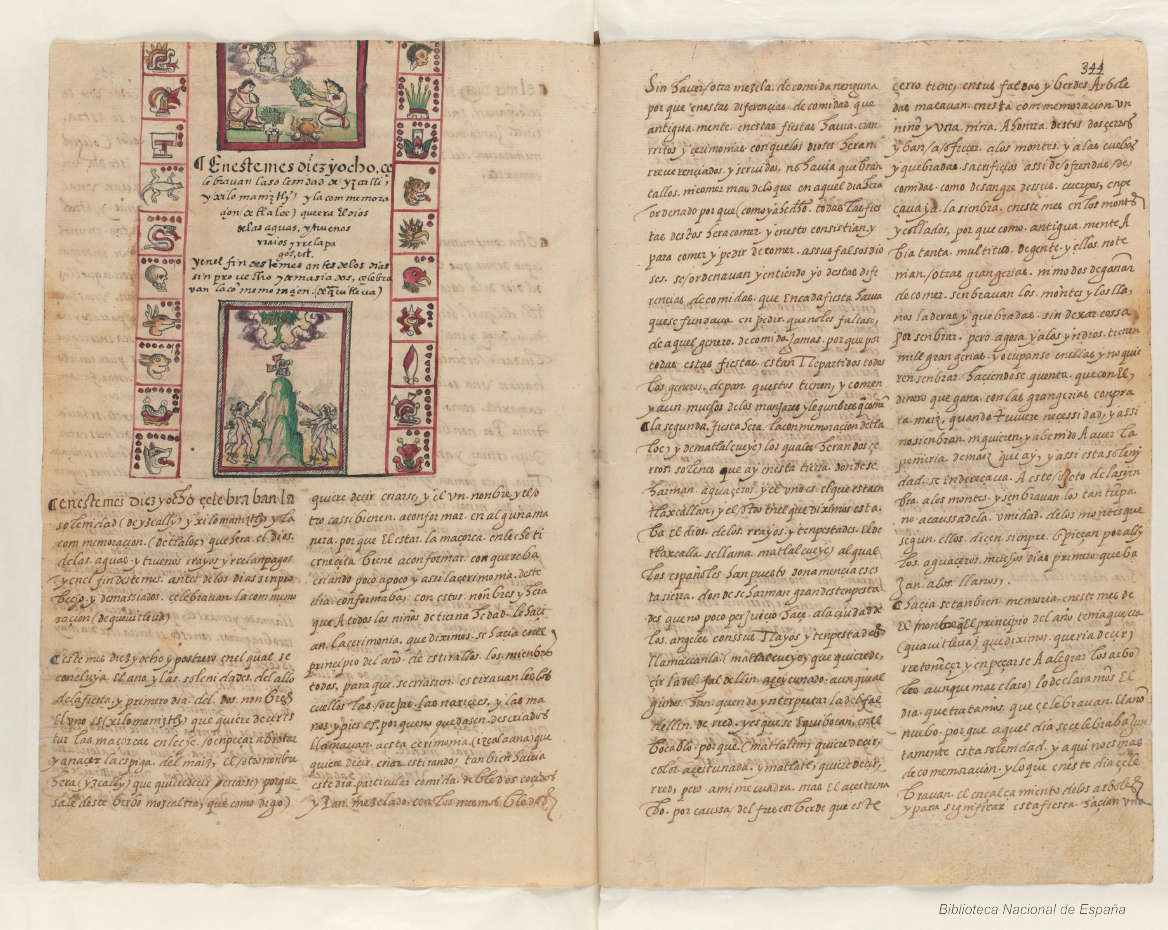
Fray Diego Durán, «El calendario antiguo», Historia de las Indias de Nueva España e islas de Tierra Firme, ff. 343r–344v, VITR/26/11, Biblioteca Nacional de España. CC BY 4.0.