Before the Forecast: The Royal Society’s Meteorological Archive as Prelude to the Met Office
Louisiane Ferlier (Royal Society, London)
Date: Friday 9 October, 5:30pm
Venue: Seminar Room 00.063, Schwarzman Centre for the Humanities
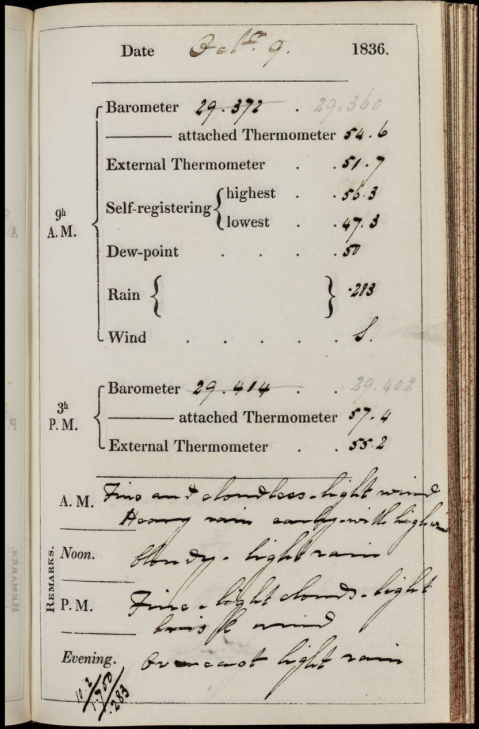
This presentation traces two key moments in the prehistory of the Met Office through the lens of the Royal Society's meteorological archives which were fully re-catalogued and digitised in 2026. The first is 1839, when the Society began consolidating disparate observations submitted by correspondents from locations around the world since the 17th century, into a coherent fond. The Chair of the Meteorological Committee Sir John Herschel described it as a "department" which would collect data for the "computists of all ages". The presentation questions whether forecasting was a central preoccupation for the archive, the standards that were adopted, the networks that participated to it and those who were excluded from it. This collecting moment also pre-dates, and quietly contradicts, FitzRoy's later claim that his 1861 forecasts marked a rupture with divinatory tradition; the Society's practice already constituted a mode of weather knowledge, distinct from folk belief, that privileged collective verification over individual prediction. The second moment is 1866-67, in the aftermath of FitzRoy's crisis: when parliamentary scrutiny discredited his forecasts and suspended the Met Office's daily bulletins, oversight passed to the Royal Society Meteorological Committee, to restore institutional credibility. Read together, these moments suggest that the Society's meteorological fonds functioned as data source from which a forecasting culture could later draw, while the Meteorological Committee acted as institutional resource that rescued forecasting once its scientific credibility collapsed. The paper closes by considering this archive, now digitised, as both historical evidence and raw material for retrospective forecasting and climatological analysis, speaking to the conference's interest in continuity over rupture and the contested construction of meteorological expertise.
All Welcome!